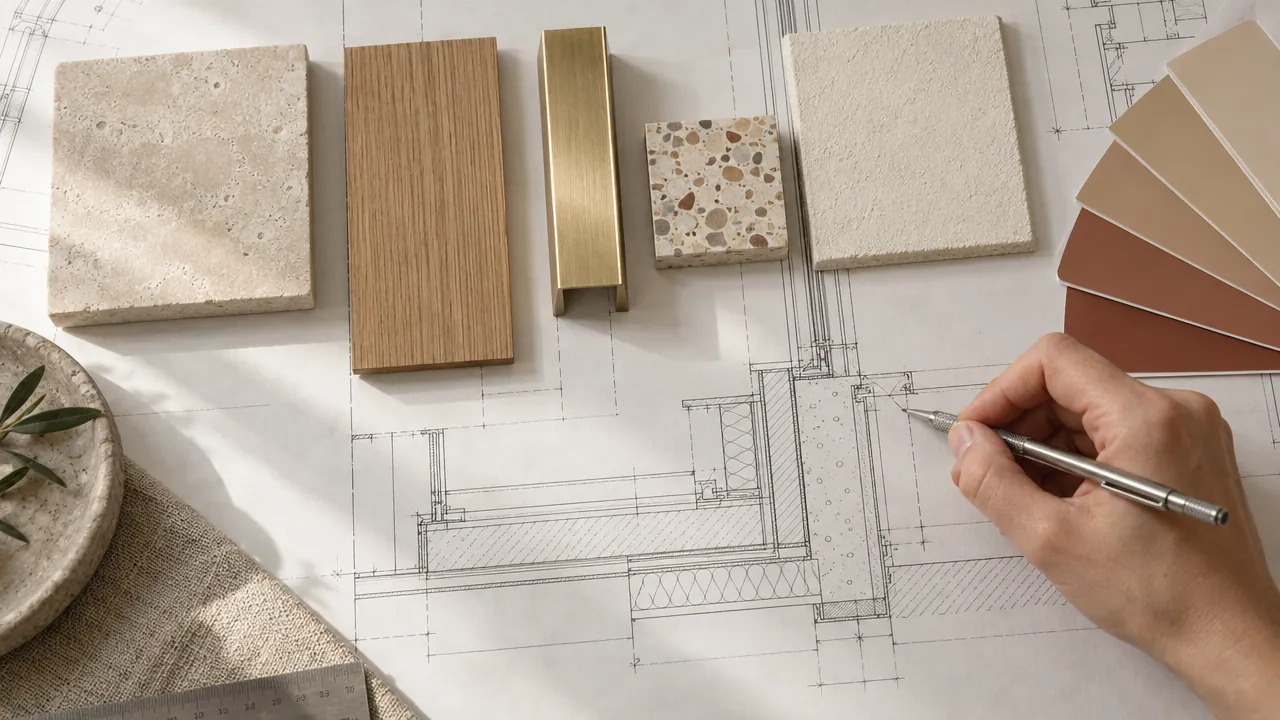
A budget band is not a commitment. It is the one piece of information that tells a designer whether to draw stone or porcelain, and it turns a first meeting from a guessing game into a useful conversation.
Why do designers ask for a budget so early?
Because the same plan can be built at very different costs. Two apartments with identical layouts can differ several times over in price, depending on whether the floors are porcelain or stone, the joinery is factory-made or hand-finished, and the lighting is a few downlights or a layered scheme. Without a band, the first design is a guess, and the second meeting is spent undoing it.
What does the band actually change?
- Finishes: porcelain or natural stone, paint or plaster, laminate or veneer.
- Joinery: modular units or full-height, made-to-measure pieces.
- Services: how much of the electrical, air-conditioning and plumbing is replaced rather than kept.
- Lighting: a single layer of downlights, or ambient, task and accent light designed together.
How do I choose a band?
Start from what you would be uncomfortable spending, not from what you hope it will cost. Our enquiry form uses broad bands in Egyptian pounds and UAE dirhams, from under 1m EGP (about 70k AED) to above 20m EGP. If none fits, choose ‘not established yet’. That is a perfectly good answer; it simply means the first conversation is about priorities rather than drawings.
When does a real price arrive?
After the survey. We give indicative structures before it, and a fixed fee in writing after it. Variations are priced at the original rates, with no percentage added on top, so the band you start with stays meaningful as the design develops.
Written by the FLKR studio in Cairo. Published .