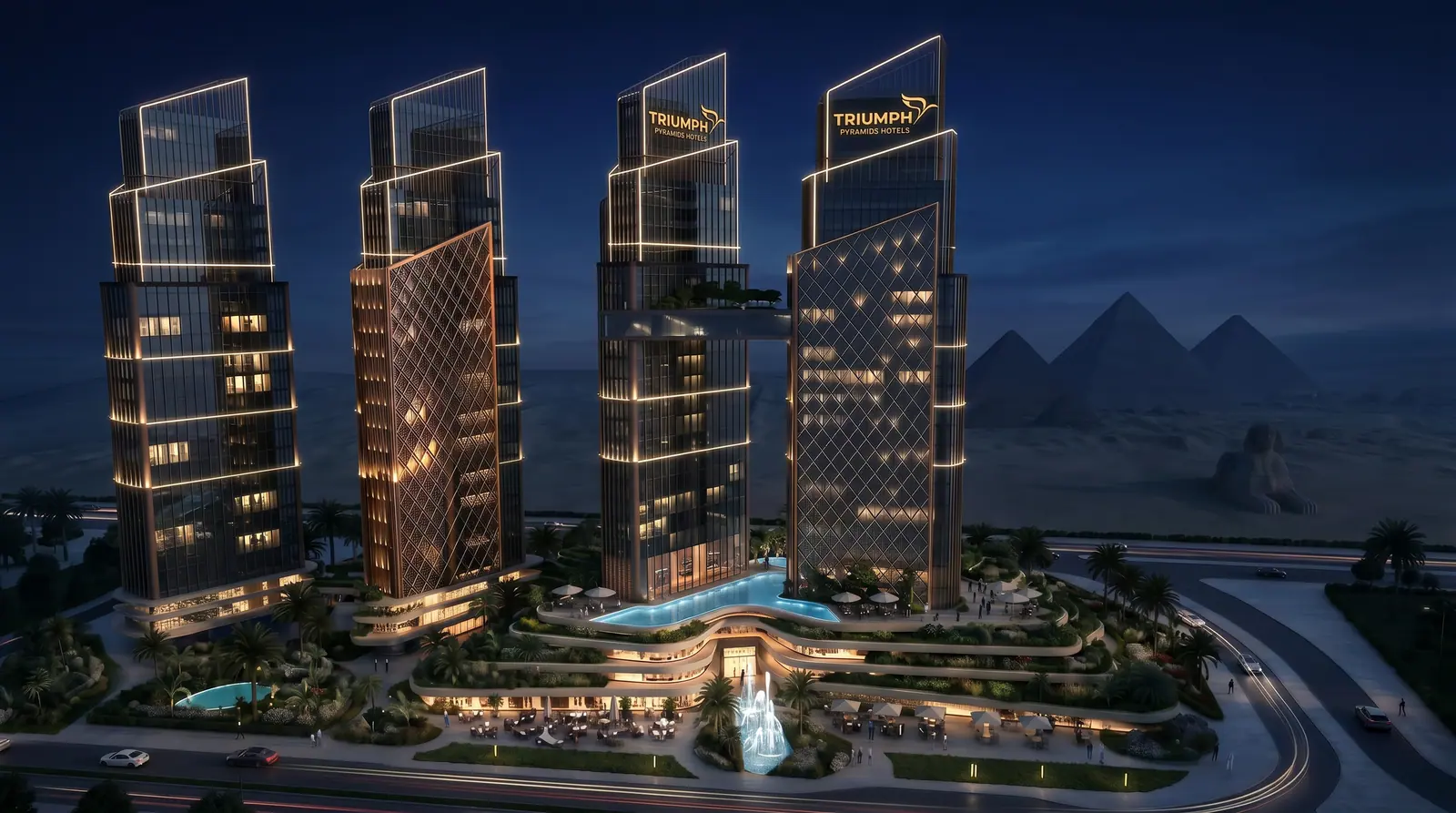
Most buildings are designed for daylight and lit as an afterthought, so they become a different, weaker building after dark. We design the night view at the same time as the day view, from the same lines.
Why do façades look different at night?
By day, a façade is read by the sun: shadows in its reveals, light on its fins, the sky in its glass. At night all of that disappears, and what remains is whatever lights were added. If those lights are floodlights washing a flat wall, the building loses its depth and becomes a bright box.
How do we keep one identity?
By lighting the elements that make the daytime shadows. On Triumph Towers, the bronze fins that shade the glass by day carry concealed linear light at night, so the same vertical lines define the building at every hour. The shape stays; only the direction of the light changes.
What makes façade lighting look expensive?
- Concealed sources: the eye sees a lit edge, never a lamp.
- One colour temperature across the building, usually warm white.
- Restraint: contrast between lit and unlit areas is what gives depth.
- No uplighting into the sky; it wastes energy and flattens the building.
We render every façade from a fixed camera by day and by night at the scheme stage. If the night view does not read as the same building, the design is not finished.
Written by the FLKR studio in Cairo. Published .