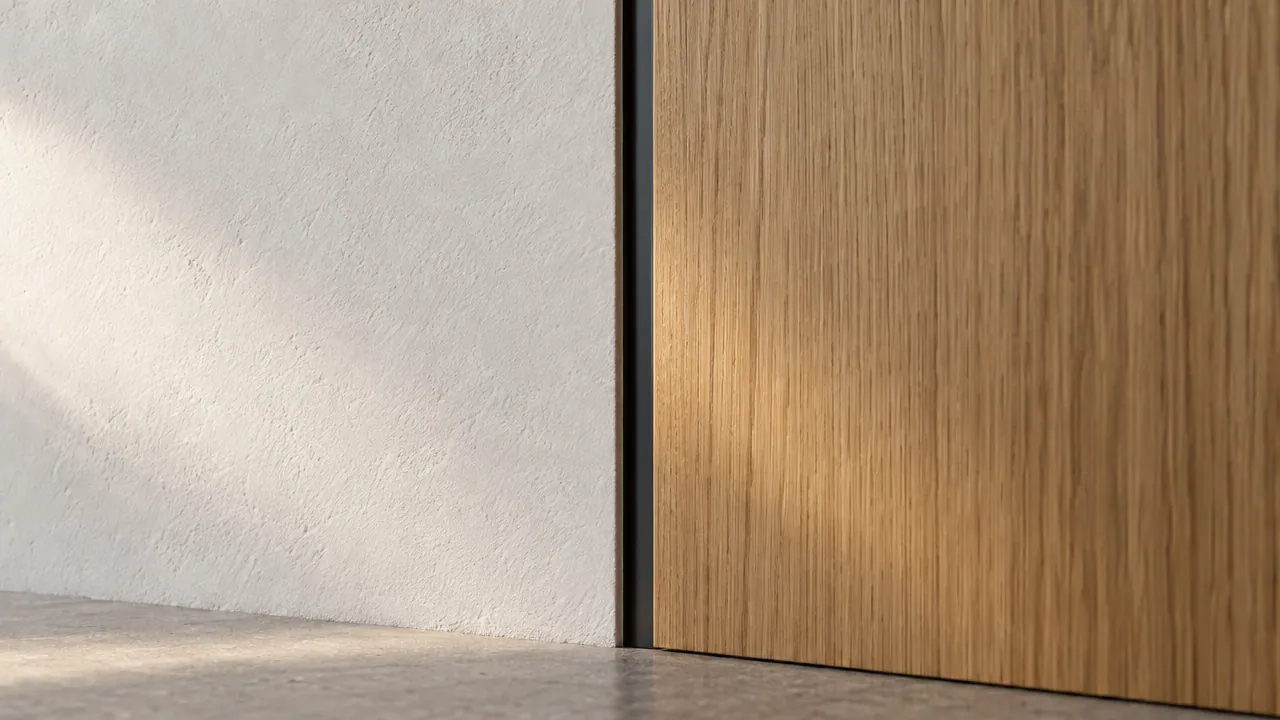
A shadow gap is a deliberate recess where two materials meet. It hides the small movements every building makes, and it is the single detail that decides whether an interior reads as crafted or as patched.
What is a shadow gap?
Where a wall meets a ceiling, a floor or a different material, something has to give. Plaster shrinks, timber moves with humidity, slabs deflect. Butt two surfaces together and that movement shows up as a hairline crack within a season. A shadow gap stops pretending the two surfaces are one: it sets them apart by a small, even recess, usually 6 to 15 mm, and lets the shadow inside it do the work of the joint.
Why 10 mm?
Below about 6 mm the recess reads as a mistake: an uneven crack rather than a line. Above about 15 mm it starts to read as a reveal, a feature in its own right, and it collects dust. Ten millimetres is wide enough to cast a clean, continuous shadow at normal viewing distance and narrow enough to stay quiet. It is also a size most trades can hold with standard profiles.
Why draw it before anything else?
Because the gap is the datum. The panel thickness, the plaster skim, the skirting, the ceiling board and the light that washes past it are all measured from that line. If the gap is drawn last, it ends up as whatever space is left over, and the space left over is never even. Our junction drawings are issued at 1:1 for exactly this reason: a tolerance that is only written in a specification gets negotiated on site; a tolerance that is drawn at full size gets built.
A tolerance that is written down gets negotiated. A tolerance that is drawn at full size gets built.
What goes wrong on site?
- The gap is cut by eye instead of with a profile, so it wanders between 7 and 14 mm along a wall.
- Painters fill it, because nobody told them it was meant to be empty.
- Lighting is added later and grazes the gap at a low angle, turning every small wobble into a shadow line.
Each of these is prevented by the same thing: one drawing, issued before the work starts, that shows the gap, its profile and who is responsible for keeping it clean.
Written by the FLKR studio in Cairo. Published .