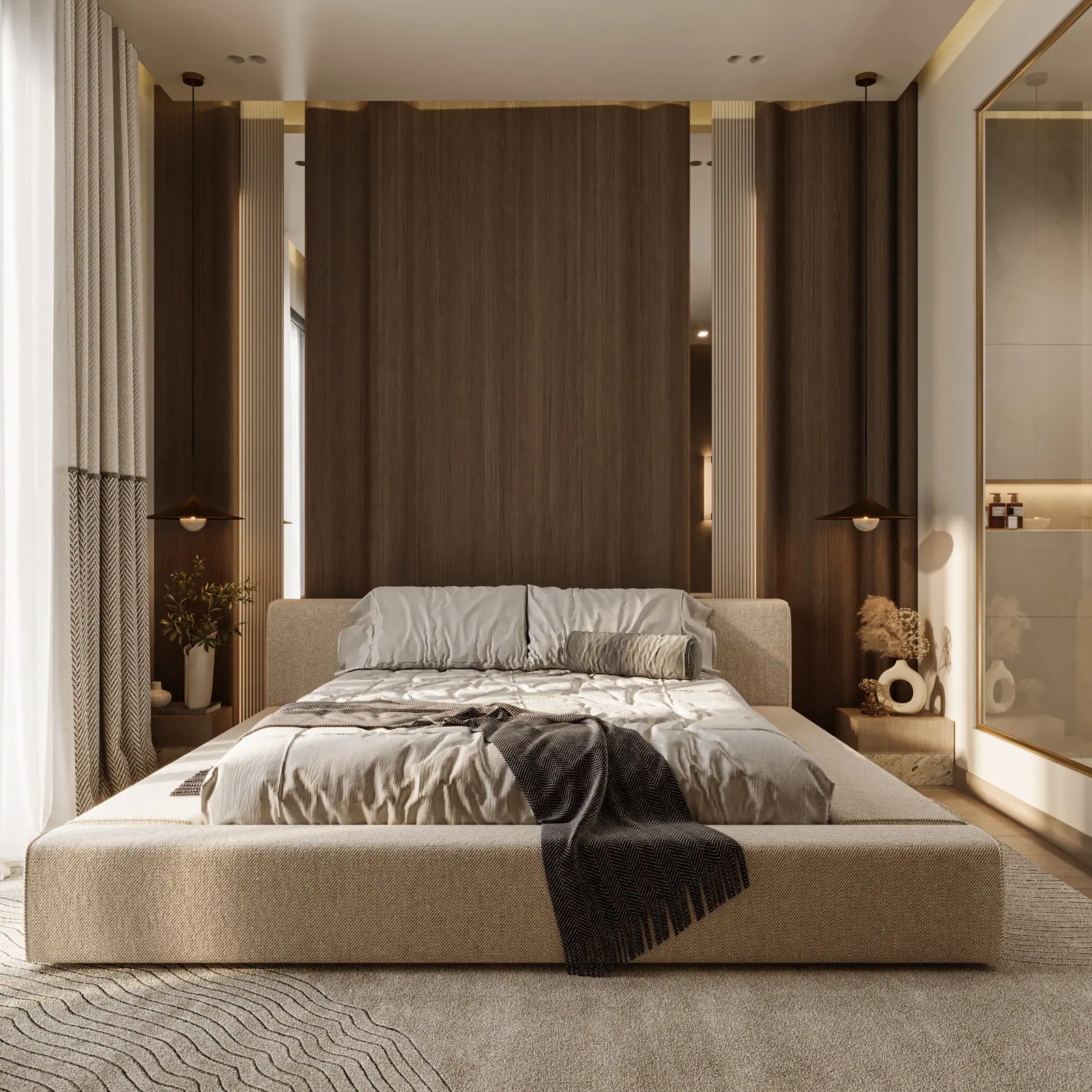
Solid timber never stops moving: it swells as it takes on moisture and shrinks as it dries. In an air-conditioned home in a dry climate, the question is not whether it moves, but whether the detail lets it.
Why does timber move?
Wood takes moisture from the air and gives it back. As the air dries, the wood shrinks; as it gets more humid, it swells. The movement is small along the grain and much larger across it, and it is larger again across the growth rings than through them. A wide solid panel can change width by several millimetres between a humid delivery truck and a dry, air-conditioned room.
Why are dry, cooled interiors harder?
Because timber is often made somewhere more humid than where it ends up. Delivered and fixed straight away, it keeps drying in place, and the gaps open, the joints crack and the panels cup. The fix is time: we bring joinery to site once the air-conditioning is running and let it acclimatise in the room before it is installed.
How do we detail for it?
- Veneer on a stable board for large flat panels, solid timber for edges and handles.
- Shadow gaps between panels, so movement shows as a consistent line, not a crack.
- Fixings that allow panels to slide, rather than glue or screws that pin them tight.
- A finish on every face, including the back, so the panel takes on and loses moisture evenly.
Timber is one of the warmest materials an interior can have. Detailed for movement, it ages beautifully. Detailed as if it were stone, it fails within a season.
Written by the FLKR studio in Cairo. Published .